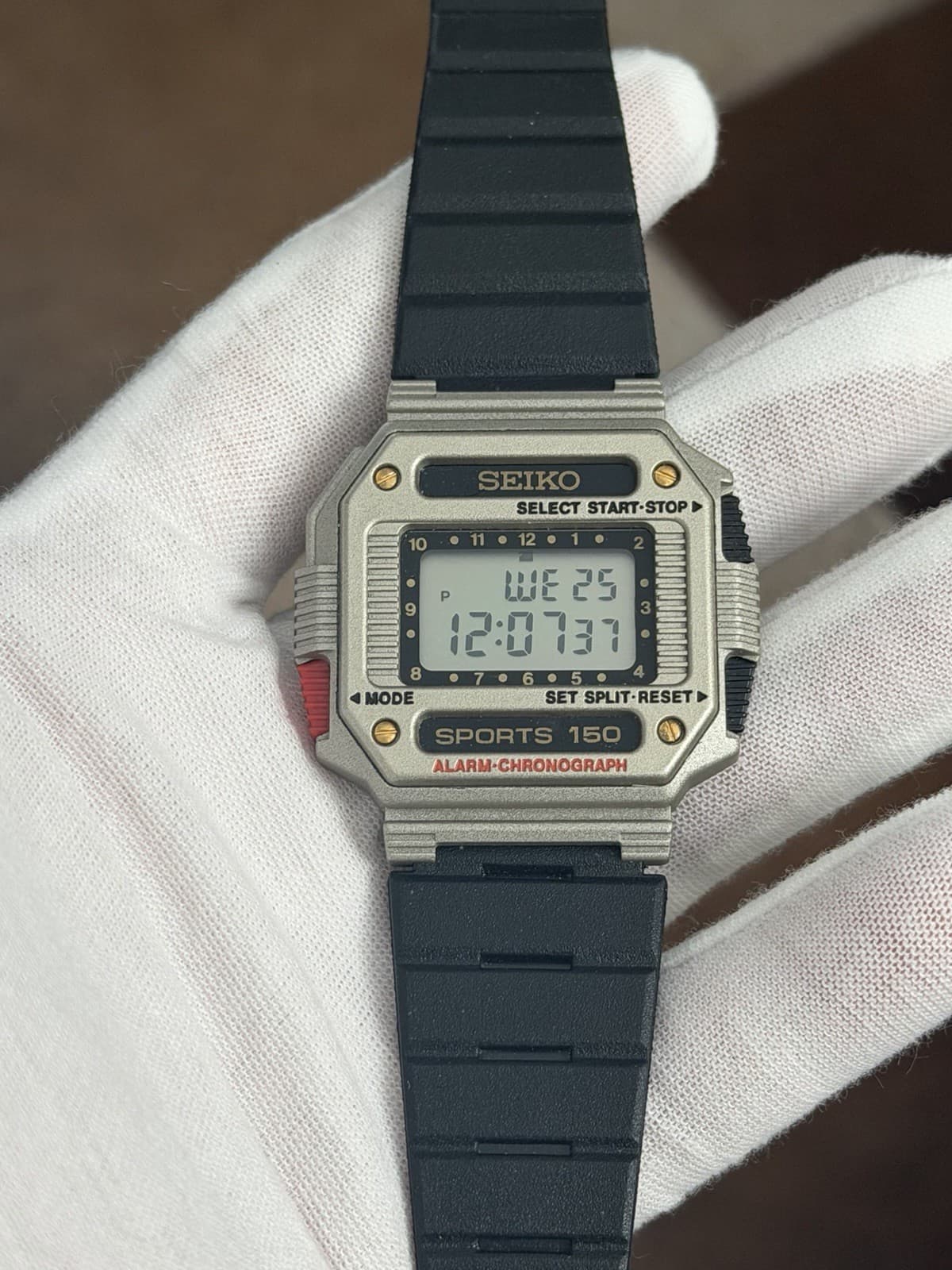
Rare Vintage Seiko A906-4A00 Men’s Alarm Chronograph Digital Sports Watch JDM
DESCRIPTION
► ARCHIVE FILE: SEIKO — BRAND HISTORY
Seiko begins with Kintaro Hattori, who opened a shop selling and repairing clocks in Tokyo's Ginza district in 1881, at the age of twenty-one. He founded the Seikosha factory in 1892 to manufacture wall clocks, built Japan's first wristwatch, the Laurel, in 1913, and put the Seiko name on a dial for the first time in 1924. By mid-century his successors ran one of the most vertically integrated watch companies on earth, making everything from hairsprings to cases under its own roof.
Postwar Seiko sharpened itself through internal rivalry: two subsidiaries, Suwa Seikosha and Daini Seikosha, competed on the same briefs, giving the world Grand Seiko in 1960 and King Seiko in 1961, chronometer-grade watches aimed squarely at the Swiss. The point was made publicly when Seiko movements climbed the rankings of the Swiss observatory chronometry trials at Neuchatel and Geneva through the late 1960s, finishing among the very best mechanical entries by 1968.
Then came 1969, the pivotal year. In May, Seiko put the caliber 6139 on sale, one of the first automatic chronographs in the world and arguably the first to reach retail; a gold-dialed 6139 worn by astronaut William Pogue aboard Skylab in 1973 became the first automatic chronograph in space. On December 25, Seiko released the Astron, the first production quartz wristwatch, priced near the cost of a small car. The Astron rewrote the rules of accuracy and set off the quartz revolution that reshaped the entire industry.
Seiko's vintage divers are a collecting field of their own: the 62MAS of 1965 was Japan's first purpose-built dive watch, the 6105 of 1968 went to Vietnam on countless service wrists and later appeared on Martin Sheen's wrist in Apocalypse Now, and the cushion-cased 6309 of 1976 became the template for decades of affordable divers. Alongside them sit the Seiko 5 automatics, produced in staggering variety, which put a reliable day-date automatic on millions of wrists for very little money.
Collecting vintage Seiko is unusually friendly to research: the serial number on every case back encodes the year and month of production, and the model and dial codes let you verify that a watch left the factory the way it sits today. Condition and originality drive value, with replaced dials and hands common after decades of inexpensive servicing, so untouched examples carry a real premium. Grand and King Seikos from the 1960s offer Swiss-level finishing at a fraction of equivalent Swiss prices, which is why their reputation keeps growing.